Showing posts with label Jack Drescher. Show all posts

Saturday, May 5, 2018

Clinical/Research News From APA’s 2018 Annual Meeting Day One

Welcome to New York City!

APA’s 2018 Annual Meeting began in New York today. From now through May 9, Psychiatric News will deliver an evening digest of some of the day’s highlights. Whether you are here in New York or at home, these reports will convey the excitement and outstanding scientific program being presented at this year’s meeting.

Drescher Recounts Long Journey for Gay Equality in Fryer Award Lecture


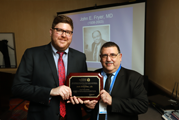
Jack Drescher, M.D., the recipient of APA’s 2018 John Fryer Award, describes how the decision to remove homosexuality from DSM changed the conversation about gay people in the John Fryer Memorial Lecture.
Read More >


Researchers Unveil New Algorithm for Treating Patients With Adult ADHD


The algorithm recommends that after accounting for any medical contraindications, clinicians should initiate treatment with a low dose of immediate-release methylphenidate or amphetamine. Read More >


University of Alabama Residents Take Top Honors at MindGames


UAB emerged victorious in a competition that pits residents from psychiatry programs across the country against each other with questions about medicine in general and psychiatry in particular. The event has become a popular attraction at the Annual Meeting.
Read More >


Experts Discuss Psychiatric Consequences of Cyberbullying


The rapid spread of personal electronic devices along with social media platforms and apps has led to a relatively new trend in bullying known as cyberbullying.
Read More >


Faith Can Shape How Some Patients Experience Mental Illness


Faith or spirituality is an aspect of humanity that inspires meaning, purpose, and hope to many people with mental health challenges and can offer fresh descriptions and new possibilities as vital complementary dimensions to the psychiatric task of soul healing. Read More >

Thursday, October 23, 2014

Psychiatrists Urged to Increase Awareness of Domestic Violence


October is National Domestic Violence Awareness Month, focusing national attention on a problem for which physicians and other health care workers—including psychiatrists—may be first responders. Psychiatrist Gail Robinson, M.D., points out that domestic violence can include physical, sexual, emotional, and verbal assault (including denigrating language and blaming the partner) and violence against objects such as punching the wall beside the partner. Robinson, who is APA’s minority and underrepresented trustee, is at the University of Toronto as director of the Women’s Mental Health Program, senior psychiatrist of the University Health Network, and a professor of psychiatry.

Robinson said risk factors for being a victim of domestic violence include observing violence between parents in the home when young; having attitudes that accept violence and gender inequality; and experiencing marital conflict or disruption. “Substance abuse and low self-esteem have been noted as increasing vulnerability to domestic violence; however, they may be a consequence of the violence rather than a cause of the violence,” she said. “Physically there may be outward signs of violence, such as bruises or fractures. If a woman is pregnant—violence continues to occur during pregnancy, often directed to the women’s abdomen—there may be at increased risk of miscarriage, premature deliveries, or small-for-date babies.”

Robinson’s advice to clinicians: “Always ask about the presence of conflict in the family when taking a history, as women find it difficult to report unless they get the sense that they will be heard and not ignored or blamed. Having pamphlets or posters about domestic violence in the waiting room can provide an atmosphere that encourages women to report. It is important for the psychiatrist to have some practical information about safety measures such as domestic violence hotlines and where to go if the woman has to leave.

Domestic violence is not exclusively a problem between heterosexual couples. A recent study found that same-sex domestic violence affects one-quarter to nearly three-quarters of lesbian, gay, and bisexual individuals—figures that equal or exceed those for straight couples. “Domestic violence can occur in LGBT families with the same frequency as it does in straight ones,” said psychiatrist Jack Drescher, M.D., past president of the Group for the Advancement of Psychiatry. “Clinicians need to be alert to domestic violence presentations in their clinical practices and to understand what kind of interventions may be helpful to their patients and their families."

Expressing support for education and outreach efforts on domestic violence, APA President Paul Summergrad, M.D., stressed that, "Domestic violence can lead to serious health problems, including anxiety, depression, posttraumatic stress disorder, and substance abuse, as well as an increased likelihood of general medical problems such as headaches, chronic pain, and poor physical health. Domestic violence is not limited by economic status, race, national origin, religion, gender, or sexual orientation.... APA strongly advocates for prevention and better detection of domestic violence, improved treatment of victims and offenders, and expanded research into causes, consequences, and prevention.” APA has posted domestic violence resources at http://psychiatry.org/domestic-violence.

APA's is holding its next #YourMH @twitter chat in observance of Domestic Violence Awareness Month. Join your APA colleagues in responding to questions and comments from the public on Friday, October 24, from noon to 1 p.m. ET. To join, use #YourMH (stands for "Your Mental Health"), @apapsychiatric, or #DVAM14. If you haven't created a Twitter account yet, click here to do so now. Here's your chance to share your knowledge and insights.

Tuesday, July 1, 2014

HIgh Court Lets Law Banning Reparative Therapies for Minors Take Effect


The U.S. Supreme Court yesterday declined to hear the appeal of a case challenging California's law barring use of so-called "conversion therapies" or "reparative therapies" to change the sexual orientation of minors from homosexual to heterosexual. The Ninth Circuit Court of Appeals had upheld the constitutionality of the law in a ruling issued last August, finding that the ban on these therapies served the state's interest in protecting minors from harm and did not violate the free-speech rights of practitioners who want to use these interventions. By declining to hear an appeal of that decision from a Christian legal aid group known as Liberty Counsel, the High Court allowed the appeals court's ruling to stand and the state to begin enforcing the law. As is customary when it declines to hear an appeal, the Supreme Court gave no explanation for its decision. New Jersey Gov. Chris Christie signed a similar law last year, but it too is facing a legal challenge.

"The Supreme Court has cement shut any possible opening to allow further psychological child abuse in California," state Sen. Ted Lieu, the law's sponsor, said Monday. "The Court's refusal to accept the appeal of extreme ideological therapists who practice the quackery of gay conversion therapy is a victory for child welfare, science and basic humane principles."

Psychiatrist Jack Drescher, M.D., who in 2000 drafted APA's position statement opposing sexual orientation conversion or reparative therapies, told Psychiatric News that,"While legislation is not the ideal way to promote best clinical practices in psychotherapy settings, the reality of what is happening on the ground left few options. The fact is that vulnerable children are being brought by their parents to 'therapists' engaging in questionable practices in order to change their sexual orientation. APA and other mainstream health and mental health organizations have found no scientific basis for the efficacy of conversion therapies, and in refusing to hear an appeal of California's gay conversion 'therapy' ban for minors, the Supreme Court has rightly acknowledged that regulating what licensed professionals can say to their patients is not the same thing as regulating free speech."

APA's position statement on reparative and conversion therapies is posted here.

(image: Brandon Bourdages/Shutterstock)

Monday, February 24, 2014

Case Examples of Harmful Reparative Therapy Sought for Legal Case


The organization Lambda Legal wishes to hear from psychiatrists and other licensed therapists who can relate real-life stories of the negative impact on and damage done to individuals who were subjected to reparative therapies as youth. According to APA member Jack Drescher, M.D. (photo at left), Lambda Legal will use the information anonymously in the preparation of an amicus brief to file in the case King v. Christie.

The case stems from a challenge to a law signed in August 2013 by New Jersey Gov. Chris Christie prohibiting state-licensed therapists from trying to change the sexual orientation or gender identity of patients under age 18. An anti-LGBT legal group immediately filed a federal lawsuit challenging the law on behalf of two New Jersey therapists and two organizations that support the use of these therapies to change sexual orientation. In November 2013, the United States District Court for the District of New Jersey dismissed the suit, ruling that the law does not violate freedom of speech or religion. The case is now on appeal to the United States Court of Appeals for the Third Circuit.

Jack Drescher, M.D., who, at the request of the New Jersey Attorney General's office, has filed a declaration in support of this law, told Psychiatric News: "I think it important for mental health practitioners who know the harm done by sexual orientation conversion efforts speak up and participate in providing further clinical material to support this law.

Drescher is a past president of the Group for the Advancement of Psychiatry and a member of APA’s DSM-5 Workgroup on Sexual and Gender Identity Disorders.

The amicus brief is due March 6. Those who would like to share case information should contact Amy Shapiro of Lambda Legal at (917) 446-7116 or ashapiro@lambdalegal.org.

The content of Psychiatric News does not necessarily reflect the views of APA or the editors. Unless so stated, neither Psychiatric News nor APA guarantees, warrants, or endorses information or advertising in this newspaper. Clinical opinions are not peer reviewed and thus should be independently verified.