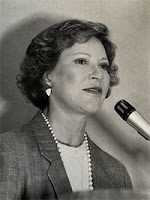
APA released a statement today commemorating the life and legacy of Former First Lady Rosalynn Carter, who passed away on Sunday at the age of 96. Throughout her public service career, Mrs. Carter worked tirelessly to improve the quality of life for people with mental illness and substance use disorders. (In the photo at left, she speaks at a special luncheon at APA’s 1985 Annual Meeting.)
“Few, if any, other Americans have been able to accomplish what she did for the cause of mental health,” APA’s statement reads. “She used her bully pulpit to bring the conversation about mental health out from the darkness and advocate for a more comprehensive system of care.”
Years before her husband, Jimmy Carter, was elected president of the United States, Mrs. Carter began seeking ways to support people living with mental illness and their families (see Rosalynn Carter's Leadership in Mental Health). As the first lady of Georgia, she served on her husband’s commission to improve the state’s mental health services. While in the White House, she served on the Presidential Commission on Mental Health, eventually helping to bring about the passage of the Mental Health Systems Act of 1980, which provided grants for community health centers.
The former first lady continued to advocate for mental health long after departing the White House in early 1981 (see Mental Health Program). From 1985 through 2016, Mrs. Carter held the Rosalynn Carter Symposium on Mental Health Policy at The Carter Center, which brought together representatives of mental health organizations nationwide to focus and coordinate their efforts on key issues. In 1996, Mrs. Carter launched the Rosalynn Carter Fellowships for Mental Health Journalism, which aims to equip journalists around the world with the tools needed to accurately and effectively report on behavioral health issues. Additionally, Mrs. Carter recognized the importance of insurance companies covering treatments for mental illnesses at the same levels as other types of medical illnesses.
“To me, it is unconscionable in our country and morally unacceptable to treat 20 percent of our population (1 in every 5 people in our country will experience a mental illness this year) as though they were not worthy of care,” Mrs. Carter wrote in a letter supporting the passage of the Mental Health Parity and Addiction Equity Act of 2008. “We preach human rights and civil rights, and yet we let people suffer because of an illness they didn’t ask for and for which there is sound treatment. Then we pay the price for this folly in homelessness, lives lost, families torn apart, loss of productivity, and the costs of treatment in our prisons and jails. … I have always believed that if insurance covered mental illnesses, it would be all right to have them. This may be why the stigma has remained so pervasive—because these illnesses are treated differently from other health conditions.”
The APA statement concludes, “An Honorary Fellow of the APA, Mrs. Carter was a friend to those whom society might otherwise have forgotten. … She will be deeply missed, and her legacy will live on for all those who are touched by mental illness and substance use disorders.”
Don't miss out! To learn about newly posted articles in Psychiatric News, please sign up here.